Radical Acceptance, Desire, Suffering, And the Ways of the Universe

As a child I had a great sense of fairness in my mind in the way I thought things worked in the world.  For one I was a good hearted kid.  I liked people and found comfort and strength in relationships.  I was also raised in church.  From the pulpit things always seem to turn out right for God’s people by the end of any given sermon.  The preacher never hooped and hollered a sad ending when climaxing the point of his message.  Then there was Hollywood.  In movies and television, the good guys always won at the end.  Justice was always served.  I recall the first time I saw the good guys ‘lose’ and a bad guy get away was in an episode of “Hill Street Blues.”  Though I don’t recall the exact details I do remember feeling jarred emotionally with a sense of loss and injustice.  Nowadays that’s pretty common for TV.  Seasons 1-5 of “The Wire” crystallized the realities of life more than any other show in television history.

For me there has always maintained this inner struggle between right and wrong, truth and justice, fairness and hardships.  All of these factors mentioned above made muttering through life mentally and spiritually difficult many a day.  I struggled with questions like why do people hurt others on purpose?  Why do good things happen to bad people?  Why do bad things happen to the good people?  Why would an elected official do evil things to the people he/she serves?  Why would a friend betray you or someone hurt you if you gave them your all?  All my life I’ve heard that doing the right things, working hard and treating people justly will bring good fortune and a good life.  I’m almost 45 years old now and through the study of history, events from around the world and life in general, it feels as if I’ve seen it all in some form or another.  And all that I’ve seen show that life is way more complicated than this.

The above mentioned formula didn’t seem to work true to life.  And most of my internal struggles have been an attempt to decipher the ways of how I fit in within the schemes of constant contradictions and suffering through good intentions.

It was my counselor and life coach Mrs. Francis Thomas (Miss Francis I call her) who first introduced to me the concept of ‘radical acceptance.’ Sitting in her office she forced me to consider ‘Letting go of fighting reality and accept your situation for what it is.’  Sounds simple doesn’t it?  Folks have a term for it nowadays.  “It is what it is.”  How many times have we heard that one?  Taking a closer look however, the concept of truly accepting things as they are is not natural to our culture.  There is and always has been a push and pull to try to influence or change reality.  And why not?  That what this country has been since immigration.  People came to this land to be what they wanted and live in a fashion empowered by personal ambition.  Those causes weren’t altogether pure either in that often living a chosen life rarely included allowing others to do the same.  And so there was and is conflict for the remaining up and comers, even till this day.  (See Colonization, Slavery, The fight for Civil Rights and Immigration)

And so we live, we love, we compete, and we pursue a vision not for what we accept but for that which we desire personally, vocationally, culturally, and institutionally.

This is our living.

And yet the midst of pursuits in happiness there is always a fly in the ointment of the oil that flows through what we call life.  Suffering.

No matter what we do, suffering seems to be inevitable.  I’ve tried to minimize mine as much as possible by following the golden rules.  But that’s too simple in the scheme of things.  So I sought knowledge.  How can I eliminate or reduce suffering?

Buddhist teaching reveals that the very cause of suffering is the attachment to ‘desire’ or craving.  The Second Noble Truth for instance include:

The Cause of Suffering– samudaya
The principle cause of suffering is the attachment to “desire” or “craving” (tanha). Both desire to have (wanting) and desire not to have (aversion).
1. Desire for sense-pleasures–kama-tanha
The desire for sense pleasures manifests itself as wanting to have pleasant experiences: the taste of good food, pleasant sexual experiences, delightful music.
2. Desire to become–bhava-tanha
The desire to become is the ambition that comes with wanting attaiments or recognition or fame. It is the craving to “be a somebody”.
3. Desire to get rid of–vibhava-tanha
The desire to get rid of the unpleasant experiences in life: unpleasant sensations, anger, fear, jealousy.
The clinging to desire comes from our experience that short-term satisfaction comes from following desire. We ignore the fact that satisfying our desires doesn’t bring an end to them.

Part of the Third Noble Truth simply says:

The end of suffering is non-attachment, or letting go of desire or craving.

In my spirit I totally understood and resonated with the substance of these words.  I sensed a light or a glimmer of hidden wisdom that I had never seen.  This was especially enlightening because by nature I am a doer, a man of action.  If I want something to be a certain way, I did what I could to make it happen.  I used action in an attempt to gain the reaction I desired. (Good deeds, hard work etc.) The thought of letting go of desire seemed to be a game changer.  A freeing experience if you will.  I started the process of embracing this concept slowly in my life.

Reading this may give the impression that by letting go of desire we are to just stand pat and allow whatever happens to happen in our lives.  That brings me to another teaching form Miss Francis.  “A life or inner peace will not consist of embracing an all or nothing paradigm.”

My journey of living is a continuous evolution of learning that the colours of life are rarely black and white, but shades of varying schemes that paint the world.  If there are no desires, there is no progress.  I believe we were created and the Universe calls for us to make contributions towards giving and receiving from the earth, as well as it’s inhabitants.  We can’t make a difference without having a ‘desire’ for something better.  Our humanity provides that we are creatures with feelings and emotions, as well as creativity and logic.  We not only want to survive, but thrive in serving and fulfilling a purpose all the while enjoying pleasure and senses of accomplishment.  The key is balancing all of life’s journey with a certain brevity and perspective.

In the bible Paul deals with this dichotomy.

In Philippians 3:14 he says he continues to press toward the mark of the high calling of God in Jesus Christ.

In Philippians 4:11 he says he’s learned to be content with whatever state he’s in.

Ecclesiastes 3 goes in great detail identifying the cycles of seasons and change in our existence.

The reality is that as long as we are living there will always be this struggle in understanding the push and pull of life; What to try to change and what to accept, how to love in the midst of hurt, pain, or rejection; Whether we are indeed living in a season or if it’s within our power to change the climate.

For in our flawed sense of justice through our blurred lenses the wicked do often prosper, good is not always rewarded, the good die young, love is not always returned gracefully.  Neither the good nor the bad are always what they seem.  And even the very best of us are often guilty of doing to others that which hurt us the most.

I submit that walking in the balance of universal harmony in the midst of it’s seemingly continuous contradictions is impossible for the natural life.  Indeed it requires a supernatural experience and existence which must be practiced if not perfected.

We should desire to be significant though not necessarily popular.  (Though being significant can bring fame.) By focusing on the process of living as well as the intent and ramifications of our actions rather than the results, in the end, I believe the Universe will balance and pay, and regulate accordingly.

And if not,… well then hey, it is what it is.
‘Why I Refuse To Join A Church (Part 2)

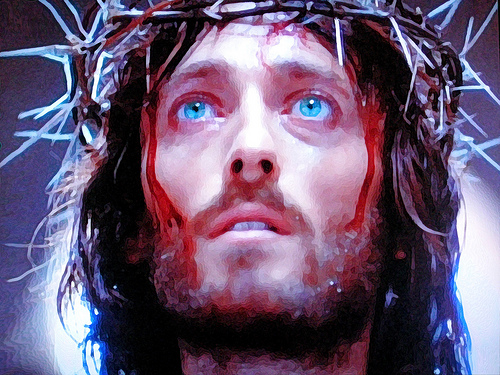
Go to church but they tease us, with a picture of a blue-eyed Jesus!  –  Ice Cube

Well, sort of.  I don’t take these lyrics from Ice Cube’s rant from his classical African-American community critique “Us” as an issue of merely color; but rather ideology.

I tried to make this point in the last church I belonged to.  Our services were tailored in a fashion that allowed us to ask questions or make comments during the sermon.  As you can imagine, that made for some memorable experiences, both for the good and not so good.  At the time George W. Bush was campaigning for a  second term in the White House.  There was a heavy religious fervor regarding that election too.  Both Catholic and Protestant organizations were galvanized similarly (if not more) than they were in 2000.

My comment during the service was that I found the election season offered at least two different Jesuses.  Immediately when I said it there were cat calls from the other members.  “Oh no, there is only ONE Jesus.”  I think they thought I was being literal.  And I found it hard to explain, as I was cut off continuously.  My point was that while most Christian churches share the same basic bible for scripture references, Jesus’ points of emphasis and agenda seemed to go down racial, class, social and political divides.

I recall visiting a prominent church in South St. Louis when the subject of the election came up.  The pastor of the church said, “I’m not going to tell you who to vote for.  But I will say that I’m not voting for someone who is for killing babies.”

I thought to myself, “Wow, I can understand Jesus being bent about abortion, but he’s not bent about torture or bombings of civilian communities?  What about all of the other injustices and crimes against humanity out there perpetrated by men for political or ideological reasons?  Is that ultimately what this election is about?”  I’ll get back to that.

Later I attended a different church for a men’s breakfast.  As usual when the subject of men come up at such an event it’s natural for the meaning of manhood and how it’s manifested in society to be brought up.  Some of the speakers made a point of making sure that homosexuality and manhood had nothing in common.  In doing so words and phrases to describe gays or being gay were slung around.  They consisted of standards such as ‘sweet’ ‘sissies’ and ‘punks’ to name a few.  Then there was the usual reference to Adam and Steve.

While all of these black macho evangelical males “amen’d” and approved of this name calling, I raised my hand and asked a question:

(Paraphrasing)

“I hear all of this name and cat calling regarding the homosexual community.  And while I respect the fact that your brand of faith entitles you the right to have your own opinion that homosexuality is a sin, do you honestly believe that Jesus would endorse the name calling that some of you are using such as ‘sissy,’ ‘punk’ or even ‘fags?’ “ 

At that point the pastor was silent.  To speak boldly like this against the precepts of leadership in a powerful black church is not something grinned upon.  But one of the elders jumped in quickly to the rescue.  With anger he burst from his seat and started spouting off scriptures in Leviticus and how homosexuality was a sin and that God didn’t like it and neither should any Christian.  He was practically foaming at the mouth from the front of the sanctuary as he looked towards my way in the back.

I reiterated:

“I’m not discussing the validity or non validation of homosexuality as a sin.  What I am asking… is that if there were homosexuals in this congregation, (and chances are there one or more among this group of men) if I were a homosexual who was struggling with my sexual identity vs. what I believe my faith allows, would your words as well as your spiritual disposition attract me to you as a source of help, or would I be repulsed, insulted or put off by your tone?  Would Jesus address a person who happens to be a homosexual with the names you choose along with your mocking tone?”  

DEAD SILENCE in the congregation.  I think some thought a fight was about to ensue.

The elder grew more angry, then shouted something else before the pastor got up and addressed my question… sort of.

“I understand what you are saying brother.  And perhaps you are right that we can do better with the name calling.  But let me be clear, homosexuality is a sin.  Now let’s move on.” 

This, among other things at that time, drew me to the conclusion that as far as the evangelical community was concerned, all God/Jesus really cared about were what I called the ‘Big 3’  Abortion, Homosexuality, and Stem Cell Research- all of which He was against.

That’s right.  Let it be known henceforth that these are the bullet points on Jesus’ hit list.  But was it really? 

The question of Jesus and the identification of his agenda have been going on thousands of years, right?  In the scriptures he seemed to identify it himself:

Matthew 16:13-15

13 Now when Jesus came into the parts of Caesarea Philippi, he asked his disciples, saying, Who do men say that the Son of man is?

   14 And they said, Some say John the Baptist; some, Elijah; and others, Jeremiah, or one of the prophets.

   15 He saith unto them, But who say ye that I am?

   16 And Simon Peter answered and said, Thou art the Christ, the Son of the living God.

In my estimation, this question is still the most divisive among Christian believers.  Who Jesus is- a direct result of what he endorses- stands for, evangelizes, and lives by.  As Christians (followers or Disciples of Christ) by very definition that agenda should translate into their own.  And this is where confusion and division has obviously settled in.

Let’s take it step by step.  While these are not absolute, I think we can agree that these are generally the focus, missions, and nature of Jesus, depending on the demographics and world view of the worshipper. 

During slavery a certain segment of the population believed that Jesus endorsed the enslavement of Africans which included selling, beating, raping and murdering people that Jesus/God created.  During this same period the slaves (often taught Christianity either from Catholics in Africa or Protestant enslaver in America) believed that Jesus would deliver them from their oppression. 

Similarly, during the Jim Crow and civil rights eras, The KKK (who defined themselves a Christian organization) believed as they do today that Jesus choose them to be superior, while other nationalities are inferior. Many churches, both black and white, believed that Jesus created, loves and values all men equally. 

These days we face many of the same challenges.  Some upwardly mobile church dogma believe that Jesus favors the wealthy while others believe Jesus is concerned for the poor.  

Let me give you a biblical example and how it may play out today:

John 6:5-14

5When Jesus then lifted up his eyes, and saw a great company come unto him, he saith unto Philip, Whence shall we buy bread, that these may eat?

   6And this he said to prove him: for he himself knew what he would do.

   7Philip answered him, Two hundred pennyworth of bread is not sufficient for them, that every one of them may take a little.

   8One of his disciples, Andrew, Simon Peter’s brother, saith unto him,

   9There is a lad here, which hath five barley loaves, and two small fishes: but what are they among so many?

   10And Jesus said, Make the men sit down. Now there was much grass in the place. So the men sat down, in number about five thousand.

   11And Jesus took the loaves; and when he had given thanks, he distributed to the disciples, and the disciples to them that were set down; and likewise of the fishes as much as they would.

   12When they were filled, he said unto his disciples, Gather up the fragments that remain, that nothing be lost.

  13Therefore they gathered them together, and filled twelve baskets with the fragments of the five barley loaves, which remained over and above unto them that had eaten.

   14Then those men, when they had seen the miracle that Jesus did, said, This is of a truth that prophet that should come into the world.

 Newt Gingrich

If something like this were to happen, one side of the Christian agenda would report it this way:

Boy donates food, Jesus takes the little and performs a miracle to serve thousands.  The people rejoice.

Another Christian agenda would report it this way:

Unemployed multitude threaten to mug little righteous boy who has food.  Jesus the self-appointed welfare socialist takes the food away from the one who had in order to spread the wealth.  Claims of a miracle go unsubstantiated, but Newt Gingrich says that Jesus should face prosecution for robbery.  Sara Palin said Jesus is an illegal alien- “just look at his name”- (Pronounced Hey-Seuss) and bad for American values.  Finally, Rush Limbaugh called him “The Magic Hebrew.” 

Ok (chuckle) I’m having a little fun with this.  But you get my point.  This conversation has political ramifications, but in this context it’s not political at all. 

I have attended many of these churches during my lifetime so I speak with experience.

The evidence shows that our depiction of Jesus, given his world view, is something either given to us by others or something we decide upon ourselves- based on our own background- sociopolitical, socioeconomic and dogmatic vantage point.  Christians decide which Jesus to follow based on what they are comfortable with.  That’s right.  Believe it or not, Christians have pretty much picked their own Jesus to worship and follow based on their own accepted set of criteria.

For those living in inner cities, their Jesus cares about the poor; thought not exclusively.  For many living in upper class neighborhoods, Jesus wants you to have riches.   Many ministers I know believe and teach directly that the level that God shows his favor and blessings upon you, and the very proof of your own level of faith is a direct result of the believer’s financial status.

 Rev Ike

Some Christians promote charity and believe that government should help with social causes.  Other Christians are for cutting any and everything having to do with helping those less fortunate.  It’s happening in this country in a big way right now.  I’m not making a judgment one way or the other but more asking why is it that so-called liberal Christians believe one thing while conservative Christians believe something else entirely – while reading the same bible?

I’ve heard it said that it’s up to moderate Muslims to speak out against radical Muslims who are for violent and other unrighteous acts done in their name.  While I agree with that I rarely see Christians doing the same. 

When have you heard of moderate Christians speaking out against Pastor Steve Anderson and Rev. Wiley Drake  for praying that President Obama dies?  Have you ever been up late and night and seen those ministry programs where they offer to sell you God’s blessing for $500-$1000?

So why not just join a church that chooses a Jesus I am comfortable with?

On the one hand, that sounds kind of attractive, right?  But on the other, I’m not so sure about that.  My own personal evangelical bent lends me to believe that God, by virture of being the creator of the universe (which includes my very existence), has the authority to demand without question first and foremost that he be in charge.  If that is the case I certainly don’t need to align myself with a church that simply makes me comfortable.  Furthermore, I can’t fathom believing in a gospel that is not transferable to any and all communities in the world.   I can’t believe a message in College Park, Georgia that could not be preached in the slums of Calcutta, India just because the economic opportunities are not the same.

The bottom line in my view is that Jesus (as we know him) has been bastardized and transformed into a political football, tossed to and fro by whoever wields his name.  He’s been labeled like soup, and packaged for consumption like a Happy Meal or an Ipad too often for the purposes of manipulation, domination, or deceit.  That’s not to say all churches, ministers, or parishioners, liberal or conservative, are all bad or good.   But what is the difference in that or any other religious group that have segments that do good work?   The point for me is that following God as I want to know him is so profoundly vital to my own spiritual growth and well-being, dogmatic preferences and spiritual limitations cancel my mere desire to belong in such a  group.

Read Why I Refuse To Join A Church Part 1 here.


What’s Wrong With The Christian Church?

wiley-drake.jpg

Well that would take all day.  Not that the church has the market cornered on ungodly beliefs and actions.  Every religion I know of has its flaws.

But since this is a mostly Christian nation and many Christians sects especially those of the Evangelical modes like to pontificate loudly when it comes to certain “choice sins”, I am always amazed when a preacher like this one can…….

here it comes…..

wait for it…..

pray for the death of the president! 

Now this is a little surprising to me but certainly not shocking.  The fact that Rev. Drake – the little ball of hate said what he did is one thing.  Neither Christianity in general nor the church specifically can be responsible for one preacher’s words. 

The question I have is why is not every Church in and out of his peer group calling for this guy on the carpet?  Why is he allowed to stand in the pulpit and preach the “Word of God”?   Where is the leadership?  Where is the righteous indignation? 

And some folk like to say that the President’s election has made us post racial?  There will be foxes and wolves in any organization.  I get that.  But the church has to police itself.  And silence on the part of those who don’t believe Jesus is calling for the death of the president is just as harmful as an endorsement.

I believe it was a Christian who said something to the effect of,

All that is necessary for the triumph of evil is that good men to do nothing.”

Personally, I tend to wonder how good the good men are these days who are leading the pulpits and allow one of their own to spew this kind of rhetoric.

Christianity and Torture

Reading this article recently strikes me as yet another reason why I question the validity, dare I say the morality of Christianity.  At least in the fashion that it’s practiced in America.  It’s not that Christianity and Catholicism for instance have the market cornered on hypocrisy.  But because of the utter self righteous way in which many Christians paint themselves, believing that everyone should think and live as they do, I don’t understand how they can reconcile the Jesus in the bible as a savior who loves them and their agenda so much.  And so it is with a survey showing that 62% of White evangelical support torture.

Let’s examine just some of the opinions in this article for instance.  My response to these will be in bold:

Rev. Ronald Kuykendall, an evangelical pastor in Gainesville, Florida, says that the question is difficult to answer because everyone has a different definition of torture. He says he would support the torture of a terrorist if “the techniques used are lawful, necessary” and the ultimate purpose is to save lives.

Kuykendall says the New Testament (Romans 13:1-7) teaches Christians that “everyone must submit himself to the governing authorities, for there is no authority except that which God has established.”

“The NT [New Testament] is clear that God grants the right of the ‘sword’ to the state to be used against wrongdoers,” Kuykendall says. “Just as I believe I don’t have a right to vengeance personally, I do believe that I can seek justice through the state and call the police on a robber, or a gunman threatening my life.”

Honestly I have no idea what he means or how this relates to torture.  But he really tried to get the scripture to endorse his support of it.  Is he saying that no matter what happens if it’s lawful then he supports it?  I would say that as a Christian he shouldn’t leave it to sinners to determine whether torture techniques are godly.  He doesn’t do that with abortion or gay rights.  Both have been lawful and yet people who share his beliefs are constantly on the fight to change the laws.  It’s as if he is complicit in support of torture but doesn’t want to get his hands dirty.  Let the “authorities” handle it.

Chuck Colson, the evangelical pastor who once served as an aide to President Nixon, answered the same question in an online discussion conducted by the Washington Post “On Faith” Web site.

Colson said that Christians are supposed to obey the law, but there may be times when there is a higher obligation, such as ignoring a “no trespassing” sign to rescue a drowning man.

“So it is with torture,” Colson wrote. “If a competent authority honestly believes that this was the only way to get information that might save the lives of thousands, I believe he would be justified.”

Again, does the comparison to saving a drowning man (saving a life) compare to torturing a man? And who defines competent?  Should it be a Christian who does the torturing?  And what if the beliefs the “authority” has are based in prejudice more than evidence?  He can “believe” the cow jumped over the moon but does that make it right?  Is this the foundation on which he is willing to stand in the face of Almighty God?


Charles Kammer, a religious studies professor, says he was not surprised to learn that a majority of evangelical Christians support the use of torture in certain circumstances.

Kammer says that despite Jesus’ own commitment to nonviolence, Christianity as a whole has never embraced nonviolence. He says some evangelicals also confuse patriotism with piety.

“What’s good for America has often been seen as God’s will,” says Kammer, who teaches at The College of Wooster in Wooster, Ohio.

“They think the torture of evil people is not bad, but may be morally required as a way of protecting the good people.”

Kammer said he is a Christian and does not support torture in any circumstances. He considers waterboarding torture.

This seems to make the most sense to me.  When I first thought to write on this topic, I thought to myself, “Since the days of Columbus and perhaps before, Christians have always killed, maimed, tortured, stole, and dominated people when it served their interest.  Why should 2009 be any different?  To say many confuse patriotism with piety is an understatement!  They believe, or at least say they believe that God is an American and that His focus is on preserving the American way of life that isolates and separates from everyone who do not share like beliefs. 

I talked to a co-worker of mine who told me that she didn’t believe that waterboarding was torture.  I asked her if she knew what waterboarding was and she said no.  I figured she had listened to Rush or Coulter.  (I swear Coulter is one of the most dangerous and sick thinkers I have ever heard.  She is definitely serial killer material.  Rush is a drug addict so I can’t take anything he says seriously.  But I digress)  Anyway, I gave her this link on waterboarding which show the lasting damage that it causes.  Read it for yourself and see.  Also, I said to her, “If it wasn’t so bad, why would the CIA bother doing it?  If one believes in torture, surely he wouldn’t do something that seems like a mere nuisance.”  She agreed, but admitted that she likes the feeling of feeling safe.  She liked the tough talk of Dick Cheney and felt that her protection was more secure with the mobster like approach.  In other words it’s better for your neighbors to fear you more than respect you.  

But she wanted my opinion as well.  So I explained to this person who has an  Assemblies of God background the virtues of neighbors this way:

You, your husband and children live in a home which resides in a neighborhood.  You have neighbors.  Perhaps you can get along ok if you held every one of your neighbors at bay with a gun.  Let’s say no one will bother you.  Everyone fears you and you feel safe. 

But let’s say you’re away from the house and someone is snooping around your property.  Well the neighbor to your right would perhaps alert you or the authorities, but they are mostly indifferent because you aren’t friendly neighbors and have no respect for one another. 

Let’s say you go out of town.  You can tell a good neighbor, “Look I’m going to be away for a couple weeks.  Please keep an eye out for my stuff.  Get my mail for me.”  Well a neighbor who likes and respects you will go the extra mile to secure your property and personal safety.  Which of these two neighbor situations make you feel safer? 

I said it’s the same with other nations.  When Bush and Cheney drew the line in the sand and said, “If you’re not with us, you’re against us,” (meaning if you don’t agree with everything we do the hell with you) it put us in a position of alienating nations/neighbors.  Perhaps that nation/neighbor wouldn’t be as excited to share information that they may have obtained about our nation’s safety that our own intelligence didn’t pick up.

I don’t want to give the appearance that war is not necessary at times.  Nor that I don’t believe a strong military is a vital part of national security.  But there are other areas that are important to.  And it takes wisdom to deliver balance and righteousness.  I simply can’t reconcile the beliefs of the Christian leadership to bear witness with my own spirit.  And this is one of the reason why it’s difficult to subscribe to believing and worshipping as they do.  Worst of all, (or not) it causes me to question and doubt the very foundations of their beliefs.

Uhhhh Not Sure I Get This…

Ann Holmes Redding says she sees no contradiction in being both a Christian minister and a Muslim.

Hey, I am a pretty liberal person when it comes to honoring people’s beliefs.  I also have many questions of both Christianity and Islam.  But claiming dual religions? 

Even I don’t get that!

This sista is confused.  Because the question of Christianity is the question of Jesus and whether he holds a place of deification, and whether he is indeed the son of god.  Christians who use the bible clearly believe that. 

This is not so for the Muslim.  They believe Jesus is a prophet like Muhammad… I would argue not even as significant. 

So she may take things from both religions that she may enjoy when it comes to worship or teachings.  But just by virtue of the doctrines she cannot be both.  It’s impossible!

BB&G Explores Religion & Political Conflict

I was watching Meet The Press on Sunday morning, and of course one of the topics featured was the current crisis between Israel and Hamas.  As Hamas fires it’s missiles and Israel advances via ground, I imagine this is partly because there is a new administration coming into power later this month.  The Bush administration is of course an unrepentant supporter of Israel.  And while Obama says he also supports the nation just approaching 60 years since their declaration of independence, I don’t think the limits are known to Jews.  They may find it to their advantage to get a foot in certain geological and political places before Obama takes over.

What fascinates me as gas prices slowly rise again in the midst of this conflict, is the age old source of the initial conflict, religion.  In this case the beef between the Jews and a particularly radical group of Palestinians. 

I grew up experiencing and participating in various denominations of Christianity.  For a time I considered myself a rather devout Christian.  Now what that means to the reader is certainly subjective as we will get into later on.  I have also questioned and taken Christianity to task on differing subject matters.  I studied religion in college as well, and that really gave me an insight into how the religious beliefs of man determine lifestyles, laws, treaties, alliances and enemies.  It is the oldest and most consistent source of conflict in the world.  And when taken to such extremes, it seems as if it will never end.  Take the discussion on Meet The Press.  One of the guest was Jeffrey Goldberg, a Jewish American writer who currently writes for The Atlantic.  He had occasion to speak with Nizar Rayyan a late military leader of  Hamas who was said to be killed on New Years Day.  In his column from January 2,  Goldberg had asked Rayyan about the possibility of peace between Israel and Hamas.  This is what he wrote:

The question I wrestle with constantly is whether Hamas is truly, theologically implacable. That is to say, whether the organization can remain true to its understanding of Islamic law and God’s word and yet enter into a long-term non-aggression treaty with Israel.  I tend to think not, though I’ve noticed over the years a certain plasticity of belief among some Hamas ideologues. Also, this is the Middle East, so anything is possible.
 
There was no flexibility with Rayyan. This is what he said when I asked him if he could envision a 50-year hudna (or cease-fire) with Israel: “The only reason to have a hudna is to prepare yourself for the final battle. We don’t need 50 years to prepare ourselves for the final battle with Israel.” There is no chance, he said, that true Islam would ever allow a Jewish state to survive in the Muslim Middle East. “Israel is an impossibility. It is an offense against God.”

And there you have it.  This guy’s way of looking at his faith, or so he said was that no way his God would allow another people to live peacefully and that the only reason for a cease fire was to load up weapons and artillery for future battles.  Now don’t get me wrong, I have opinions on this as well as other conflicts both current and historical.  This “Deity Factor,” a phrase I coined in college which I will post later explains this perfectly.  But that is not the purpose of this post or the series which I plan to explore for the week.

My question is how do we deal with religion in the 21st century.  I see religion as a binding entity that has helped a lot of people.  I see it as a unifying force that allow great things to be accomplished among followers.  Through it people learn discipline, submission, and servant-hood as there is a recognition of a higher power beyond human domain.  Religion has sparked many humanitarian efforts all over the world through aid in the midst of wars and natural disasters for instance.  Equally, religion and religious ideology has also been the source of most wars around the world.  Historically, one religion cannot exist without some group of another trying to eradicate it from the earth in the name of said religion.  Religion has divided nations, torn brotherhoods asunder, killed babies and colonized generations of people.  People have ravaged lands, raped women, burned people alive and even attempted to wipe an entire ethnicity off the face of the earth – all in the name of religion and a brand of faith.

As sophisticated and technologically sound as we are in this nation with our computers, internet, satellite and space shuttle capabilities etc., primal religion and faith are still the straw that stirs the drink of American thought and motivation.  I don’t care how secular some say this nation is, make no mistake about it;  A major play in this past presidential election as well as the two previous are fundamental religious beliefs among Americans. 

This week I would like to explore that thought, provoke some conversation and get the opinions of ordinary people about the state of religion and how it effects our lives.  Of course we can’t cover every aspect, but I would like to start the year by exploring what is THE most significant factor of political and personal thought. 

Is it possible to exist with a people who don’t believe another people should exist?  Are we too radical in our approaches, not just them but us?  (Whomever us is) Do we question the origins of our own beliefs enough?  Do we respect others who do not believe as we do?  Are we doomed to just fight one another until the end of the earth?  All this week as we cover different topics surrounding religion, I invite you to just talk about it.  Maybe we can come up with some ideas, perhaps start a positive movement.

Peace

Money, Moral Conflicts, & The Blessing of Personal Integrity

 $20 dollar bill

Ok, so I worked my ASS off this past week officiating middle and high school basketball games.  It’s been a marathon ride to say the least.  Since the first of December I have done 42 games.  Yes I said 42 which includes 18 over the past weekend.  Depending on the school, or the tournament the pay can vary.  But steady work is always good regardless especially in these economic times.  As an official, I am basically an independent contractor.  To get games, people have to recognize you for being consistently good and diligent in your duties.  (Not to mention the politics at times.)  I am still getting to know people though my name and reputation are getting out there. 

I found myself having a dillemma when I received my final pay for the games over the weekend.  The tournament director overpaid me by $20.   That’s easy to understand considering it was  a terribly long weekend for him.  Not only did he organize and direct the games, he also coached his own set of kids who made it to the finals.  He was trying to be in 10 places at the same time.  Well he paid me my dividens as we made small talk about the tournament.  He then thanked me and went about his business of putting up chairs and heading the cleaning crew.  Inwardly it seemed as if he may have gave me slightly more than he was supposed to.  I folded they money and slid it in my jacket pocket and walked away.

Once I got to the car, I counted the money to make sure.  YEP he gave me an extra $20.  What was I to do now?  Immediately I went evangelical stereotypical greedy excuse making Christian and said to myself, “Gee what a blessing!  Shoot I can use that extra money.  I’ll consider it a tip for all of my efforts!”

Then my conscious is like, “Negro please.  That ain’t no blessing.  The man made a mistake.  Give him that money back.”

I’m pacing in front my car, knowing what the right thing to do was, but trying to convince myself why I shouldn’t do it.  It didn’t work.

This is what came into my spirit.

“If you believe in the universal laws of fundamental right and wrong, karma and goodness, then you understand the blessing that was already before you as you were able to work these and many other games in the first place.  Your body is healthy, car is running, got a roof over your head and people like the job you do.  Are you willing to sell your personal integrity for $20?” 

The answer was a very easy one.  “Hell no!

With that I walked back into the gym and sought the director out.  He was paying some other officials and when I got his attention, I whispered into his ear, “Here, you paid me over by $20.”  A happy yet exhausted man’s eyes lit up.  He chuckled at me as if I were some kinda wierdo and handed the money back to me with these words.  “Merry Christmas.”

Surprised I said, “Ahh man thanks!”  I walked out the gym with the extra loot, thinking about how it would suffice as gas money.  But I admit that the money itself paled in comparison to that which I gained that cannot be paid for, my self respect.

Commentary from Nafees A. Sayed – by way of CNN.com

Harvard University student Nafees Syed says both candidates should reach out to Muslims in the U.S.

CAMBRIDGE, Massachusetts (CNN) — During this election, we have seen the spectacle of two presidential candidates fighting over one voter while snubbing an entire segment of the American population worthy of their attention.

We in the Muslim-American community look wistfully at people like Joe the Plumber, wishing that we too could be courted for our vote by the presidential candidates.

At the same time, we look gratefully at figures like former Secretary of State Colin Powell, who reassure us that there is hope for greater acceptance of Muslim-Americans.

Over time, we grew to expect standoffish treatment from the Republican Party. Almost a decade ago, many Muslims, my parents included, supported President Bush for his humble foreign policy stances, strong family values and reaching out to the Muslim-American community.

Things have obviously changed since September 11, 2001, and we have grown used to anti-Muslim rhetoric from Republican candidates. We have run like refugees to the Democratic Party, only to find reluctant tolerance and hope that we will go somewhere else.

American civil rights activist and intellectual W.E.B. Du Bois wrote, “[The American Negro] simply wishes it possible to be both a Negro and an American, without being cursed and spit upon by his fellows, without having the doors of Opportunity closed roughly on his face.”

Over a century later, I and many other Muslim-Americans feel the same, hoping that we can be accepted in America as both Muslims and Americans.

As a college student voting in my first presidential election, I have been inspired by Barack Obama’s call for change. My campus is full of Obama posters, and several of my classmates have taken time off to work for his campaign.

There is no doubt Obama has the Harvard vote, but my vote will not be cast as enthusiastically as others.

This campaign means to me what it means for my classmates. In the next few years, the economy and American foreign policy will affect my generation unlike any other, and those concerns are the primary influences on my vote.

However, as a Muslim-American, I see some issues as more personal. I don’t blame Obama for clarifying that he isn’t a Muslim; if someone misidentified my religion, I would likewise point out the facts, especially if it was part of a larger smear campaign. However, as the first Muslim Congressman Keith Ellison stated, “A lot of us are waiting for him to say that there’s nothing wrong with being a Muslim, by the way.”

Indeed, Obama’s responses to accusations that he is Muslim should be more than just denial; they should be a condemnation of the prejudices that lace such accusations.

When I discuss this issue with fellow Muslim-Americans, especially ones who have dedicated significant time to his campaign, I immediately hear that he’s just doing what he needs to do to win.

I respond skeptically to these arguments. Is it really politically necessary for Obama to avoid visiting mosques — something that President Bush has dared to do — while rallying support from churches and synagogues? Doesn’t his careful distance from the Muslim-American community contradict his message of unity?

Still, others, my parents included, advise that it is best that we as Muslim-Americans avoid marring his campaign with our visible support at a time when any connection with Muslims would jeopardize his chances of winning. They reason that we have to politically isolate ourselves for the better candidate to win, a sacrifice we should make for our country.

I am unwilling to feign political apathy. All I want is for one of the candidates to assure me and the American public that “Muslim” and “American” are not mutually exclusive terms.

Colin Powell’s recent interview with Tom Brokaw has left me with some hope. He highlights the flaw in the question of Obama’s religion with the answer, “he is not a Muslim; he’s a Christian. … But the really right answer is, what if he is? Is there something wrong with being a Muslim in this country? The answer’s no, that’s not America.”

To prove his point, Gen. Powell recounted the story of Purple Heart- and Bronze Star-winning Kareem Rashad Sultan Khan, an American soldier in Iraq who sacrificed his life for his country. He represents a Muslim-American community that is dedicated to its country and worthy of the presidential candidates’ attention and respect.

It is a tribute to Gen. Powell’s own dedication to his country that he would take note of the treatment of Muslim-Americans during the elections.

Thanks, Gen. Powell. You said the words that Muslim-Americans around the country were waiting to hear.

Joel Osteen’s Alright With Me…

josteen_250.jpg

I am not much on preachers on TV.  I am not much for preachers at all.  Not that I don’t appreciate the men and women who really seek to make positive change and be a conscious for spiritual/universal truth.  I know of a few who are in this for the right reasons.  Far too many seem to be full of themselves, their “ministries” their dogma or their legacies.  I think many ministers (Christian in particular) start out as humble servants.  But when they achieve a certain amount of notoriety they change.  In short, many begin to overestimate their own importance in the grand scheme of things and leave the flock behind their cloud of ego driven dust.  Some are just pimps from the word go.  They enjoy not having a real job.  For them ministry is business first and foremost – and if people fall by the wayside, oh well.  Though I have seen this with my own eyes several times within my life, a few honest ministers have confessed as much to me during interviews.

When I look at Joel Osteen, I see something different, something refreshing.  Back in the day when his father John Osteen pastored Lakewood Church, my dad was a member there when he moved to Houston.  It was there that his own interest in ministry began to thrive.  When John passed away, Joel took over the pulpit and began to do his own thing.  When I surfed the channels and stopped on one of Joel’s messages, I smirked and said to myself, “He’s not a preacher, he’s a motivational speaker.”  Every message to seemed to be about how, “everything was going to be alright and God loves you just the way you are.”  Well, since I grew up in just about every church sect in the US, I wanted something stronger, more meaty.  I had heard everything and I wanted something to challenge me.  He was not doing it.  So I chalked him up to be another PK (Preacher’s Kid) who took over his father’s ministry but has no real depth himself.

Well after taking another look at Joel from the time I saw him on 60 Minutes, I have done a 180 on him.  I recently took the time to pay closer attention to his messages.  And what I see that I didn’t recognize initially is that Joel ministers something that is very needed in today’s world.  He offers hope, faith, and an outlook that allows one to view challenges with a glass “half full” mentality.  Also Joel is one who totally promotes personal responsibility.  He makes us fully aware that we are responsible for our own happiness as well as the task of making good decisions to put ourselves in position for success.  All the while his encouraging style allows us to forgive ourselves and turn the page on past mistakes, and turn towards the right path.

I got mad love and respect for Joel Osteen.  I know that he believes everything he says which is one of the greatest compliments I could ever give any person.  He reminds me that no matter how complicated the problem, the ways of working through the solutions are layered with simplistic truths and principles.  A small change in perspective can make the difference.  That is as much meat as a person needs during times like these.